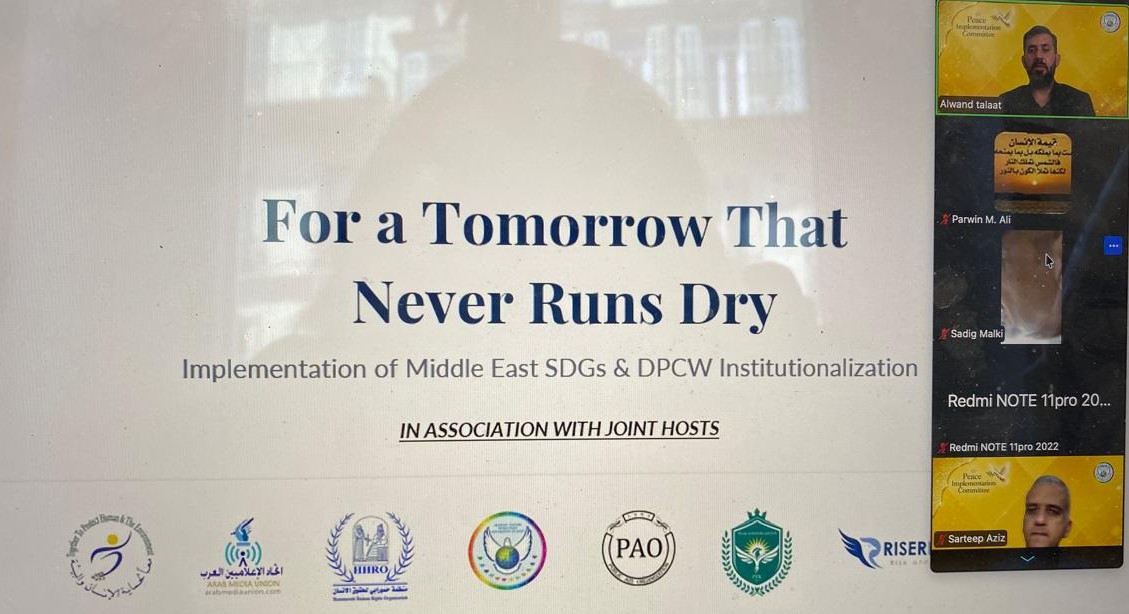

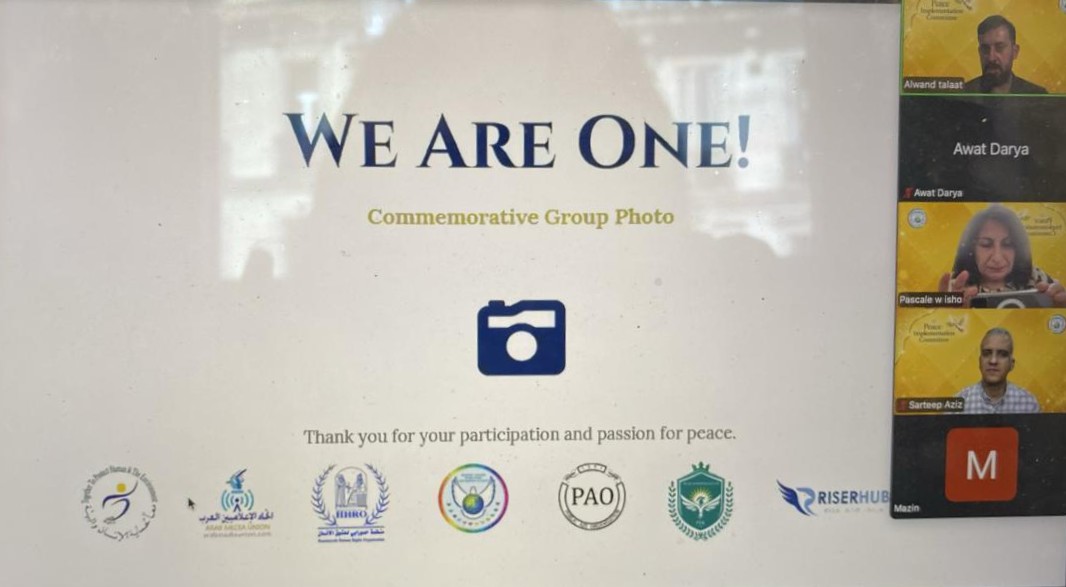
Mrs. Pascale Yohanna Isho (Warda) President of the Hammurabi Human Rights Organization, along with several members and friends of the organization, participated in the international virtual conference held under the theme "For a Tomorrow That Never Runs Dry." The conference included a number of partners working in the field of peacebuilding, including the Hammurabi Human Rights Organization.
Mrs. Warda opened the conference with a welcoming address, conveying the Hammurabi Organization's greetings to all attendees. She emphasized that establishing peace has always been the shared goal uniting the organization with HWPL and its international and regional partners.
She stressed that sustainable peace is a fundamental human right and a universal right that concerns all of humanity, based on the belief that humanity is one entity with a shared destiny.
Mrs. Warda affirmed that the Hammurabi Organization continues its efforts, in line with the HWPL motto "We Are One," to promote the goals of sustainable peace in Iraq and the Middle East. The conference focused on consolidating the principles of the Declaration on Peace and Cessation of War (DPCW) and transforming it into an institutional framework supported by local government institutions, civil society organizations, and relevant partners involved in promoting a culture of peace.
The conference also addressed the efforts of the Peace Committee in Iraq and the Middle East in capacity building, training peacebuilders, and fostering dialogue, understanding, and fraternity among communities. It emphasized that the DPCW, which includes ten fundamental articles for establishing global peace and ending armed conflicts, is a key initiative launched by the South Korean organization HWPL to promote and solidify a culture of peace internationally.
The conference reviewed several successful international experiences in adopting the principles of the Declaration, showcasing examples from various countries and institutions that have taken practical steps to support sustainable peace. These included Mali, Tanzania, the US state of Georgia, Mongolia, the Dominican Republic, Madagascar, and India. The Latin American and Caribbean Parliament (PARLATINO) also supported the Declaration through its extensive network of parliaments and legislative bodies.
Participants highlighted the importance of continued collaborative efforts to transform a culture of peace into an institutional and societal approach capable of reducing conflict and violence and promoting peace. The values of coexistence, tolerance, and respect for human rights.
In this context, the Hammurabi Human Rights Organization affirmed its continued efforts to raise awareness of the principles of the Declaration of Peace and Cessation of War within Iraqi academic circles and civil society organizations, based on its conviction that sustainable peace constitutes the fundamental guarantee for protecting human rights, preventing violations, and consolidating social stability.
The conference also addressed the close relationship between sustainable peace and the Sustainable Development Goals (SDGs), the global framework adopted by the United Nations to achieve development, prosperity, and peace by 2030. Participants emphasized that achieving these goals requires a stable environment characterized by peace, justice, and effective partnerships between governments, societies, and civil institutions.
The conference concluded by stressing the importance of continued international, regional, and local cooperation to support peace initiatives, enhance the role of civil society organizations in promoting a culture of dialogue and understanding, and build a more secure and sustainable future for generations to come.